Hey, kiddos, I’m back at it with the memes.
Well, less memes and more internet linguistics (which can encompass memes), because no one can say that we all talk the same on the internet as we do in real life. I’m not just referencing the less formal English we employ in text messaging versus the formal, correct English that we use in academic papers. I’m not just talking about a lack of grammar and punctuation. Internet linguistics is not just incorrect English—it’s a new form of English. And it couldn’t have happened without social media.
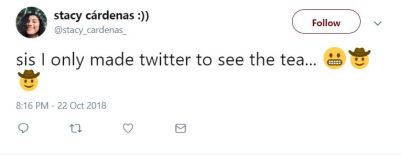
But first let’s elaborate on what I mean by internet linguistics. If anyone has ever spent time on some form of social media, especially limited character-count platforms like Twitter, they’ve probably seen some example of Internet English. Of course, there’s the invention of new internet-based slang (e.g. trolling, hashtag, “the tea”, etc.), but I’m also referencing the sheer shift in sentence structuring and order of words and the new definitions of words and just the smashing of keys to create unintelligible string of letters.
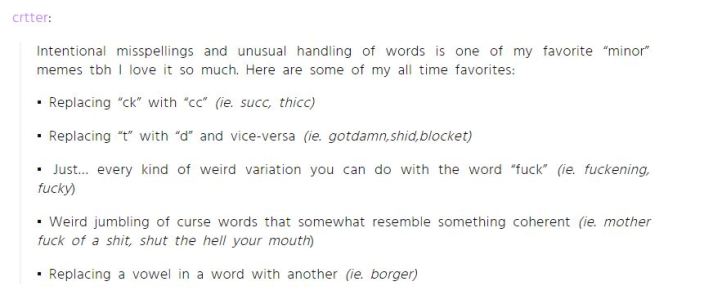
For example, take the phrase “I can’t even.” We all know that it means, loosely, “I have no words to accurately describe how this makes me feel.” It’s not a complete sentence. It has no solution. Yet we all have probably seen it somewhere on social media and understand the meaning behind that specific sentence fragment. Internet English has reached a point that even itself has become a meme. Tumblr user crtter sums up this phenomenon in this post:
Social media platforms can probably at least partially be blamed for this shift in English. Twitter’s 240-character limit (remember when it used to be only 140?) and (the now deceased) Vine’s six-second videos, for example the one below, provide only a brief window for conveying thoughts, so it is no wonder that internet communication has largely taken up these structures.
Of course, not everyone views this as a variant of English. There are still many out there that just see internet linguistics as “wrong” instead of a natural evolution of the English language. So what do you guys think? Are internet linguistics a logical reshaping of language to fit our needs? Or is this just a bastardization of the English language? Let me know what you guys think!
____________________________________________________________________________________________
Sources
 the treachery of text [this is not a blog]
Hayley,
You taught me something new. I didn’t know “the tea” meant gossip. 🙂
Pat
LikeLike