So recently I’ve made some questionable decisions.
Most notably, I gave myself a stick and poke tattoo.
Yeah, yeah, I know. Risk of infection, I’m not a professional, etcetera, but that’s not the part I want to talk about. I’d rather talk what I tattooed and then what path of thought that led me down regarding social media. First things first, I chose to tattoo a small historical symbol featuring my own little twist. I won’t get into it here, but it did spawn the whole reason for this post.
Said reason being symbolism. Specifically symbolism, social media’s effects on it, and the irony behind it all.
Symbolism is everywhere. Hate symbolism is everywhere. And it breaks my history major heart to see such ancient symbols bastardized from their true meanings to fit horrendous viewpoints. So I want to walk through some common symbols we see in many places and how easily they’ve been reduced to a joke or have even been turned into banners for white supremacists, neo-Nazis, alt-right groups, and more. I want to talk about how social media is complicit in reinforcing these symbols and their portrayed meaning into the human mind and how that contributes to the way we perceive not only those symbols, but those who utilize them.
Symbols. I’m only going to cover two common symbols here, one lighter and one heavier in the human psyche, but believe me when I say there are more. So up first in my all-important list of corrupted icons is something relatively harmless in modern society: the Eye of Providence.
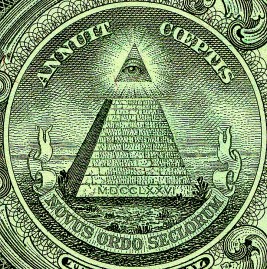
I hope everyone has seen the Eye of Providence, or the all-seeing eye of God. I mean, if you’ve seen National Treasure or the back of a U.S. one-dollar bill (Fig. 1) then you’ve seen the Eye of Providence. It’s the triangle with the eye in it with the rays of light bursting out from the edges? Oh shit, you’re probably thinking, the Illuminati.
Wrong. Ironically, the Eye of Providence has its origin in Christian iconography and represents the eye of God watching over everyone. Religiously, it conveys the idea of God’s omnipresence and divine providence and is still used today in church architecture and Christian art. So where’s the connection between the Illuminati and the Eye of Providence? The link is the Freemasons. Let’s go back to the 18th century. Wow, so much happened in only 100 years. Coincidentally, it’s also the century that the Bavarian Illuminati, an enlightenment group that opposed superstition, obscurantism, religious influence over public life, and the abuses of state power, was established. This is the group that the Illuminati we all know today is allegedly linked to. So about the Freemasons and the Eye of Providence. Back in the 18th century, Bavarian Illuminism held a lot appeal and influence in Masonic lodges, which also utilized the Eye of Providence as a symbol of God as the Great Architect of the Universe. Thus, as the Freemasons became linked to Illuminism then the Eye of Providence was henceforth connected to the Illuminati and everything it became. Today, the Eye of Providence has come to be associated with conspiracy theory regarding world affairs, government, and the “New World Order”.
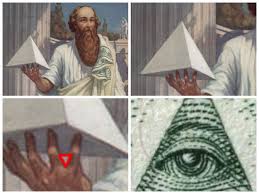
This instance of symbolic perversion is relatively harmless. It has led to some funny memes (Fig. 2) involving the Illuminati and really holds no serious impact on the social world around us, even if the Christian origins of the Eye of Providence are often forgotten in favor of its seemingly far more interesting connection to conspiracy and political intrigue.
However, not all symbols have been so lucky. There are those icons out there that have been used as rallying points for hate, oppression, and otherwise terrible human rights offenses. Let’s move on to one such example.
The svastika.

Listen, we probably all know the svastika (or swastika) but let me give a quick history lesson anyway. When I type svastika, I am typing the original Sanskrit word for “good fortune” or “well-being”. First emerging in Eurasia, this hooked cross is roughly 7000-years-old and is held sacred by Hindus, Buddhists, Jains, and Odinists (Fig. 3). While it also has some significance in European history, it wasn’t until the 19th century that it experienced a resurgence. Even then and moving into the twentieth century, however, it was widely interpreted as a symbol of good luck and fortune. Well, until the Nazis got their hands on it. The Nazi swastika is perhaps most iconic, appearing on the red flag as well as on arm bands, medals, banners, and other decorations of the Third Reich (Fig. 4).
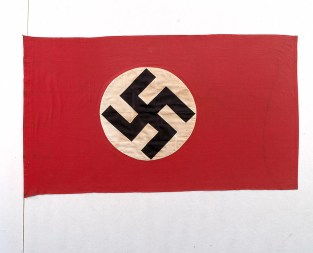
Of course, the Nazis weren’t the only far-right and fascist group to utilize the swastika, but they were the most prominent. An icon formerly signifying good fortune and well-wishing had come to be known as the banner of a racially “pure” state and was saddled with all the horrific atrocities that the Nazis committed. And it hasn’t gone away. The swastika is perhaps one of the most notorious hate symbols in at least recent history, if not the history of the entire world. As sickening as it is, the swastika is no longer used for its original intentions; it’s not even dead. It’s still being thrown around under its bastardized purpose by modern alt-right groups, neo-Nazis, and white supremacists, especially in the United States where the physical land was untouched by the horrors of World War II and the firsthand encounters with the armbands, flags, and banners emblazoned with the hooked cross were just distant ideas and pictures on the propaganda.
Social Media. Both of these symbols I’ve explained here saw their distortion happen long before the advent of social media. However, that’s not to say that social media has done them any favors in the today’s world. For both the Eye of Providence and the swastika, social media has only further cemented an incorrect perception in the minds of modern people. And why wouldn’t it? Social media can be an immensely helpful tool for spreading ideas and their icons to an audience size that Hitler could only dream of. You have posts, avatars, profile pics, headers, banners, ads, whatever. The number of platforms alone that are available to spread ideas—as well as access these ideas—is part of the reason these symbols have seen such a massive resurgence.
For the Eye, social media meant it was more or less turned into a meme, used to entertain and tied to a “secret society” that holds next to no lasting social impact on our world. But for the swastika, groups like the neo-Nazis and alt-right use social media like a weapon, planting these symbols at the forefront of a digital campaign largely centered around hate and white supremacy. For an example, just look at the videos from the riots in Charlottesville, Virginia, in 2017 (Fig. 5).

Hate symbols, including the swastika, are all over those August days. But they served to further root an ideology—that of white supremacy and neo-fascism—into the minds of those that saw them. Human beings are visual creatures; through repetition, those that use these symbols will eventually overwrite everything else in that symbol but their own cause. I’m not blaming social media for erasing these symbols’ history, but I am recognizing how easy it makes it for people to stop thinking critically about the propagandist elements these groups are employing. It’s the true irony of the internet that these symbols’ history and original meaning are only a few clicks away and yet people choose to remain ignorant and instead swallow whatever new meaning they’re told.
Obviously, I can’t stop people from taking something and twisting it away from its true meaning, but I can at least attempt to urge people to think critically—not about the iconography of the alt-right and neo-Nazis, but about how social media plays a role in the cementation of their ideas in our minds and in society.
____________________________________________________________________________________________
Sources
https://www.businessinsider.com/what-all-seeing-eye-of-providence-means-illuminati-conspiracy-2018-3
https://gwmemorial.org/blogs/news/the-eye-of-providence
https://www.britannica.com/topic/illuminati-group-designation
https://encyclopedia.ushmm.org/content/en/article/history-of-the-swastika
https://www.adl.org/education/references/hate-symbols/swastika
 the treachery of text [this is not a blog]
Hayley,
Wow, that’s some interesting stuff. Thanks for the history lesson. So, what is a stick and poke tattoo?
Pat
LikeLiked by 1 person
Pat,
A stick and poke tattoo is essentially a hand-poked tattoo. The tattoos we immediately think of are often done with a tattoo machine, which is a lot faster and essentially more efficient than poking each little dot individually like you would with a stick and poke. It takes a little more effort and a lot more time, but basically anyone can do it (not that everybody should!).
-Hayley
LikeLike
Hayley,
Holy crap! Trust me I get all of this, and sometimes its just infuriating how people translate things these days. As an English major, I know that everything in life can essentially become a symbol to a group, or a lone individual. However, I can not think of two more iconic symbols than the two that you have spotlighted. But I do have to say this as a consideration. As my high school lit professor used to say “does everything only have one meaning, or belong in one iconic cannon”. I realize that’s more of a literature thing, but the same can be said for art and these two symbols. Yes, we as a global culture have lost the traditional meaning behind the swastika/svastika and merely associate it with the Nazi party or Hitler; even though it came from Sanskrit with an entirely different connotation and denotation. Then the Eye of Providence is indeed Christian in its original context, but if we really think about sacred geometry this is an easy conclusion. In sacred geometry, a triangle if pointing up is considered to be a male symbol, then attach the idea of it pointing in three separate directions signifying omnipotence, which in sum leads us to associate it with a higher power (or so said Tim Ziaukas). Ultimately what I am getting at is that I agree with you, but it will take a lot more than a single person voice to change an almost +80-year view on the svastika, and who knows how old view of the Eye of Providence.
Devyn
LikeLiked by 1 person
Devyn,
That’s actually an awesome question to ask and as an answer I can say that no, I don’t think symbols should have one meaning. I think what truly bothers me is that any past meanings of both those symbols have been discarded or forgotten, probably faster than usual thanks to social media. Maybe that’s just the history major in me! Maybe it’s not about changing the view, just bringing attention to the original.
-Hayley
LikeLike
Wow, that is a lot of information to process. It’s so interesting to see the thing you write about because it’s usually something I’ve never thought of. You’re right though, people should stop and think about the symbols they use and all their meanings before throwing them around for some random purpose.
LikeLiked by 1 person
Symbolism is huge nowadays, for instance if companies want a product to sell, they need a really good looking logo. Everyone wants to make a symbol that can be seen from anywhere in the world and their products would be identified. If you see a apple bit on the side with a leaf above it, what would you think about? Some basic symbols have changed over time. The most noticeable case is the pound symbol, or as most people know now as the hashtag.
LikeLiked by 1 person